
Certificate in Strategic Operations Management

Uncategorized
Wishlist Share

About Course

This programme develops participants’ ability to design and implement effective operations strategies that align with organisational goals. It covers key areas such as process optimisation, lean management, capacity planning, and digital transformation. The course emphasises efficiency, quality improvement, and resilience in operations. Participants will learn how to analyse operational performance, implement process improvements, and manage risks in dynamic business environments.

Delivery Mode: Online (Self-Paced), Hybrid
             CPD Hours: 30 hours
 

What Will You Learn?

  • Design operational strategies aligned with business goals
  • Implement process optimisation
  • Evaluate risk and operational efficiency

Course Content

Module 1: Operations Strategy Fundamentals

  • Unit 1.1 What is Operations Strategy?
  • Unit 1.2 Strategic Alignment
  • Unit 1.3 Competitive Strategies
  • Unit 1.4 Operations Decision Areas
  • Unit 1.5 Operations Strategy Frameworks

Module 2: Lean Operations & Process Improvement
SUMMARY Lean Operations & Process Improvement Lean Operations & Process Improvement is a professional certificate course designed to equip learners with the knowledge, skills, and practical tools needed to improve organizational performance through the elimination of waste, optimization of processes, and continuous improvement of operational activities. In today's highly competitive business environment, organizations are under constant pressure to deliver high-quality products and services, reduce costs, improve efficiency, and respond quickly to customer demands. Lean Operations provides a systematic approach to achieving these objectives by focusing on activities that create value for customers while eliminating those that do not. The course introduces learners to the fundamental principles of Lean thinking, which originated from the Toyota Motor Corporation Production System and have since been adopted across manufacturing, healthcare, banking, logistics, retail, education, and service industries. Lean focuses on maximizing customer value with the least amount of resources, time, effort, and waste. Participants will learn how organizations can streamline workflows, improve productivity, reduce defects, and enhance customer satisfaction through effective process management. A major focus of the course is the identification and elimination of operational waste. Learners will examine common forms of waste, including overproduction, waiting time, unnecessary transportation, excess inventory, unnecessary motion, defects, overprocessing, and underutilized employee talent. By understanding these sources of inefficiency, organizations can redesign processes to improve performance and create more value for customers. For example, a manufacturing company that produces more products than customers currently demand may incur high storage and inventory costs. By implementing Lean principles such as Just-in-Time (JIT) production, the company can produce goods only when needed, reducing inventory costs and improving cash flow. Similarly, a hospital experiencing long patient waiting times can apply process improvement techniques to streamline patient registration and treatment procedures, resulting in faster service delivery and improved patient satisfaction. The course also explores widely used Lean and process improvement tools, including Value Stream Mapping, 5S Workplace Organization, Kaizen (Continuous Improvement), Root Cause Analysis, PDCA (Plan-Do-Check-Act), and Performance Measurement Systems. These tools help organizations identify inefficiencies, solve operational problems, and establish a culture of continuous improvement. For instance, a logistics company may use Value Stream Mapping to analyze its order fulfillment process and discover delays caused by unnecessary approval stages. By removing these bottlenecks, the company can reduce delivery times and improve customer service. Likewise, a bank may implement the 5S methodology to organize workspaces and digital records, improving employee productivity and reducing errors in customer transactions. The course further emphasizes the strategic importance of Lean Operations in achieving operational excellence. Learners will understand how process improvement initiatives contribute to lower operating costs, improved quality, increased flexibility, enhanced employee engagement, and stronger competitive advantage. Organizations that successfully implement Lean practices often experience significant improvements in efficiency and customer satisfaction while maintaining sustainable growth. For example, an e-commerce company may apply Lean principles to optimize its warehouse operations, reducing order-processing times and ensuring faster deliveries. A university may improve its student registration process by eliminating redundant administrative steps, leading to a better student experience and more efficient use of staff resources. Throughout the course, participants will engage with practical examples, case studies, and real-world applications that demonstrate how Lean Operations and Process Improvement principles can be applied across different industries. By examining successful organizational improvement initiatives, learners will develop the analytical and problem-solving skills necessary to identify operational challenges and implement effective solutions.

Module 3: Risk Management in Operations

Module 4: Digital Transformation in Operations

Module 5: Capacity & Resource Planning

Earn a certificate

Add this certificate to your resume to demonstrate your skills & increase your chances of getting noticed.
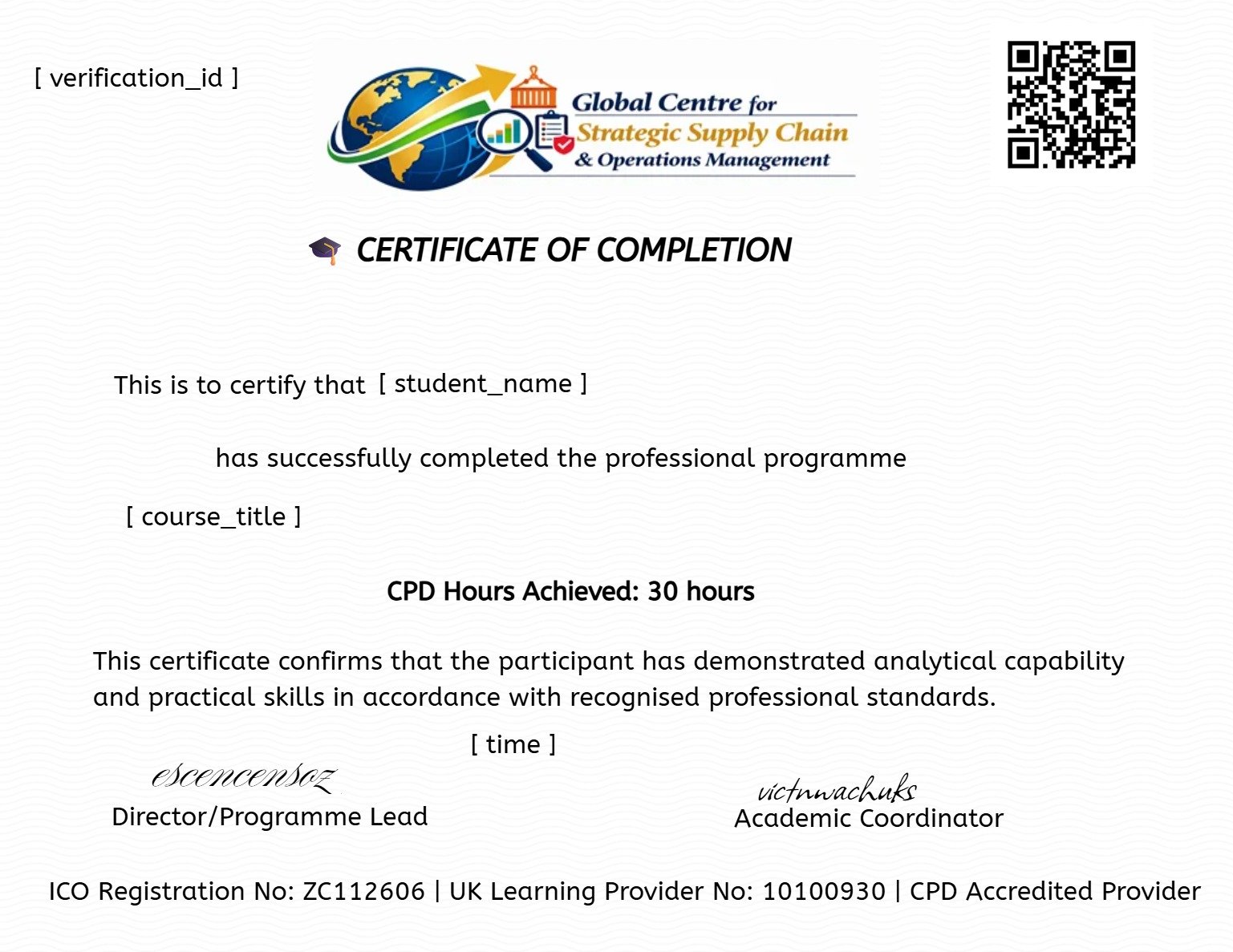
selected template

Student Ratings & Reviews

No Review Yet
No Review Yet

Want to receive push notifications for all major on-site activities?

✕